Friday, March 8, 2013

Taken from Eleanor Farjeon 'The Last Four Years' .1997 Sutton Edition

Edward and Merfyn went on a week's holiday in 1913 on the Norfolk Broads with Eleanor Farjeon and two friends of hers. He went fishing every day without catching a thing, and he and Eleanor walked together. The friends left a day early and Eleanor, Edward and Merfyn spent another night and day together. What must that have been like for Eleanor, I wonder. She says nothing about that.


Edward Thomas on the Water


publishingmyedwardthomas.blogspot.com         -  from now on please.


Merfyn took the photo of the four adults - Edward and the other man holding plates behind their heads at Edward's suggestion - pretending to be saints with haloes. And here is Edward Thomas washing up.

'The River Isis

On the right is the gold-and-white barge of Magdalen College undergoing repair. The masts and barges of other Colleges line the side of the river, and Folly Bridge closes the prospect.'
'Oxford', 1903
(One barge remains, upstream from Donnington Bridge. It's someone's home but open during Artweeks, May 4th onwards this year.)

More Boats

Edward was a keen rower when he was at Oxford and would have rowed between the boat-houses near Folly Bridge and Iffley lock. He wrote in 'Oxford' about the races between colleges - it sounds just like today's except that now, of course, there are women.

c.Sarah Lawrence
The Poem - quieter waters -this is quite the most contented poem of Edward Thomas I know.
July

Naught moves but clouds, and in the glassy lake
Their doubles and the shadow of my boat.
The boat itself stirs only when I break
This drowse of heat and solitude afloat
To prove if what I see be bird or mote,
Or learn if yet the shore woods be awake.

Long hours since dawn grew, - spread, - and passed on high
And deep below, - I have watched the cool reeds hung
Over images more cool in imaged sky:
Nothing there was worth thinking of for long;
All that the ring-doves say, far leaves among,
Brims my mind with content thus still to lie.
------------------------------------------------------------------------------


A local footnote.

I walk from Donnington to Iffley most days even though sadly without our beloved Greg who died in January 2012. (We are still looking out for another dog - ideally a mongrel puppy- hard to find.)
Over the last few months the lock at Iffley has been very unsightly but interesting, as the lock gates are being replaced. I spoke to the carpenters today, asking what wood they were using. It's Ekki and Greenheart - tropical woods that are too dense to become saturated under water. They are Stewardship approved, he told me.
I was surprised that they use wood, not steel these days, and elsewhere they have used steel, but apparently these wooden gates should last sixty years. Steel lasts about forty.
One of the new gates visible.

Wednesday, March 6, 2013

One more setting, the one I haven't visited - Franconia, New Hampshire, USA


Well, I won't be the first - I remember the novel by Stef Penney, 'The Tenderness of Wolves' set in a bitter Canadian winter so powerful it was almost a character in the novel: people were rather amazed to find that she'd done all the research online. I think that's perfectly fair. What would not be fair would be to use someone else's work of fiction for the same purpose - facts and images, yes, someone else's fictional use of their work, no.

It was very much helped for me that the farmhouse Robert Frost bought in June 1915 still stands. It is now called The Frost Place and is a museum and centre for poetry and Frost Studies.


Genuine or not, this image appears everywhere
There are so many images of it it's hard to choose - do have a look at their website, http://frostplace.org

Photo-Jeannine Atkins'journal

I'm inclined to think, though, that you gain most from visiting writers' locations by looking at the view from their windows, or in this case, the porch. That's certainly what they would have spent a great deal of time doing.


An extract from the novel:

'In July the Frosts moved in to the farm. Robert and Elinor were ready to meet the removers who brought their long-stored goods on a wagon. All their old possessions from the Derry farm piled higgledy-piggledy in the kitchen, and the men clumping about heavily upstairs could not spoil their elation. Elinor did become thoughtful as she looked out of the kitchen window: how well she would come to know that view, those tall weeds where the kitchen water was thrown out, over the years ahead. Many years maybe, even though they were not so young and all their long past years were piled up there, in the chaos of the kitchen at her back.

‘My, am I glad to have a home of my own again,’ Elinor said.

‘Yes, and such freedom – our own birch woods. No one to tell us what we can and can’t do, where we can and can’t go. I couldn’t have taken that one moment longer. But we had some good times in England, didn’t we, Elly?’

‘Well, some, I guess.’

‘And it’s turned out for the best, you must admit that.’

‘I know.’

A few days later they moved in with the children, the younger three running off together to the Hyla brook. Lesley climbed Ore Hill and after a while ran down towards them.

‘I’ve found a great crop of blueberries all round the wood over there – do come see.’

So they picked blueberries, they fixed up the house and swam in the brook that hot summer. Robert and the children went back to playing baseball. It was Carol, at fourteen, who was to work the farm: Robert believed that a son must earn his father’s love but his mother’s is rightly there for free.

Robert himself began to be busy with writing, organising his work and with Poetry Society matters. The little post-office at Franconia, where their mail was retained for them, had never known such mail as arrived daily for Mr Robert Frost.

But Elinor was not wholly content for long.

Robert would sit out on the white-painted porch, gazing into the autumn morning. He liked to see the mist clear and the mountains take up their true shapes while the last shreds of mist remained only in the deepest valleys.

‘He’s watching the dragon come out of the Notch,’ the children said. It was the Franconia Notch, the saddle of the mountain facing them. He had always believed that you could not get too much winter in winter, something he’d missed in England. He was beginning to wonder, though. Would they pay for their mountain view with too harsh and bitter weather? Would his plan for orchards fail? One late frost would kill the early blossom. '
Robert both composed new poems and revised for publication the work he had done in England. He published Mountain Interval in 1916. It contains many of his best known shorter poems. The Exposed Nest, Locked Out, the Sound of Trees and Putting in the Seed are all Leddington and Ryton work. The 'tricky' Road Less Travelled is part of the collection, and Out, Out, The Hill Wife, The Oven Bird.


  • Published Henry Holt, 1916

  • The Frost Copyright has to be respected but I am sure these poems, over 75 years old, are out of copyright. Here is ' Birches' which I think is Franconia inspired.
    Birches
    When I see birches bend to left and right
    Across the lines of straighter darker trees,
    I like to think some boy's been swinging them.
    But swinging doesn't bend them down to stay
    As ice-storms do. Often you must have seen them
    Loaded with ice a sunny winter morning
    After a rain. They click upon themselves
    As the breeze rises, and turn many-colored
    As the stir cracks and crazes their enamel.
    Soon the sun's warmth makes them shed crystal shells
    Shattering and avalanching on the snow-crust—
    Such heaps of broken glass to sweep away
    You'd think the inner dome of heaven had fallen.
    They are dragged to the withered bracken by the load,
    And they seem not to break; though once they are bowed
    So low for long, they never right themselves:
    You may see their trunks arching in the woods
    Years afterwards, trailing their leaves on the ground
    Like girls on hands and knees that throw their hair
    Before them over their heads to dry in the sun.
    But I was going to say when Truth broke in
    With all her matter-of-fact about the ice-storm
    I should prefer to have some boy bend them
    As he went out and in to fetch the cows—
    Some boy too far from town to learn baseball,
    Whose only play was what he found himself,
    Summer or winter, and could play alone.
    One by one he subdued his father's trees
    By riding them down over and over again
    Until he took the stiffness out of them,
    And not one but hung limp, not one was left
    For him to conquer. He learned all there was
    To learn about not launching out too soon
    And so not carrying the tree away
    Clear to the ground. He always kept his poise
    To the top branches, climbing carefully
    With the same pains you use to fill a cup
    Up to the brim, and even above the brim.
    Then he flung outward, feet first, with a swish,
    Kicking his way down through the air to the ground.
    So was I once myself a swinger of birches.
    And so I dream of going back to be.
    It's when I'm weary of considerations,
    And life is too much like a pathless wood
    Where your face burns and tickles with the cobwebs
    Broken across it, and one eye is weeping
    From a twig's having lashed across it open.
    I'd like to get away from earth awhile
    And then come back to it and begin over.
    May no fate willfully misunderstand me
    And half grant what I wish and snatch me away
    Not to return. Earth's the right place for love:
    I don't know where it's likely to go better.
    I'd like to go by climbing a birch tree,
    And climb black branches up a snow-white trunk
    Toward heaven, till the tree could bear no more,
    But dipped its top and set me down again.
    That would be good both going and coming back.
    One could do worse than be a swinger of birches.


    Has anyone been to the Frost Place? It would be so interesting to have comments from you.

    Sunday, March 3, 2013

    Edward Thomas Fellowship Birthday Walk at Steep.

    Today, 3rd March, the annual walk at Steep marking Edward Thomas birthday went well. It began in near freezing temperatures but at about 2pm the sun shone, The familiar format is a longish morning walk and a shorter afternoon one, interspersed with readings.
    Exceptionally, today we were joined by a Radio 4 reporter and sound engineer who recorded people on the walk, including me. There will be five broadcasts over Easter - whether all Edward Thomas, or walking groups, or South Downs, I'm afraid I'm not sure but with Robert MacFarlane contributing it will be good.

    What was very good for me was to meet face to face two people I've known of and wanted to meet, Fran Howard-Brown, wise maternity nurse/adviser, also  a regular Edward Thomas correspondent on dovegreyreaderscribbles to which I've often referred, and Lucy Milner, Edward's great-granddaughter, Merfyn's grandaughter, daughter of Edward Cawston Thomas.
    Here is Lucy reading The Brook, the poem  which features her great-aunt, Myfanwy.  I transposed the scene to Leddington in the novel:
    'They travelled so speedily that they reached a place they’d never visited, where a stony track forded the Preston Brook. Myfanwy paddled. Edward sat on the bank by the glinting, murmuring stream. A dragonfly suddenly landed on a large stone by the water’s edge and warmed itself, taking heat from the stone and sun together. There it stayed motionless and timeless, as he felt himself to be, sitting there in the sun.

    Above the trees he could see March Hill, the last of the Malverns, prominent against the sky, a place of legends and ancient mysteries. He pictured Thomas Traherne, sitting in the Herefordshire sun centuries before, meditating on the boundless potential of man’s mind and spirit and enjoying the easy hours as a child did. He would have to read Centuries, again – such extraordinary and unconventional verses. Traherne’s ‘child’ was a marvellous creature who could wander free of boundaries and had no property to bind him. Traherne saw that we don’t own the world or any part of it, at best we hold it on an everlasting lease.

    For a while he lost all sense of present time, of time itself. A walk like this, a place like this, took him meandering through the centuries. It was as if he and the dragonfly were unchanged since Traherne’s days. Or even since the long-dead chieftains were buried in the barrow up on the hill. This was England for him: timeless, the England that had roots far back in the earth of the ancient past and that still in moments like these could be found.

    A chaffinch flew down and perched on the wooden rail of the bridge, cocking its head a little and looking into the brook. How contained they are, he thought, the dragonfly, the chaffinch; these creatures aren’t troubled like us, always reflecting and theorising. They have intuition and a wholeness of being. We are cast out from that – the Fall, there’s a real truth in the story. These creatures are still in Eden, they’re in touch with the world, with now, in some immediate way that Man never is. We have history – our awareness of human history, those barrows, the past and what it gives us. And our own pasts.

    And along with that is the fact that we’re always thinking of the future too, he thought. Children escape that for a little while, before schooldays at least. He watched Myfanwy building a row of stones across the stream - even she had a clear plan, she couldn’t leave the stream to be itself. It was the nature of Man. But then of course the stream would win. Within minutes of their leaving the little dam would be gone. He could foresee that, but it was his belief that the only certain thing about the future was its unpredictability.'


    Next was The Chalk Pit, a rather Frosty, dialogue-based poem:


    From The Chalk Pit
    'Is this the road that climbs above and bends
    Round what was one a chalk pit: now it is
    By accident an amphitheatre.
    Some ash trees standing ankle-deep in brier
    And bramble act the parts, and neither speak
    Nor stir.' 'But see: they have fallen, every one,
    And briar and bramble have grown over them.'
    'That is the place. As usual no one is here.
    Hardly can I imagine the drop of the axe,
    And the smack that is like an echo, sounding here.'
    'I do not understand.' 'Why, what I mean is
    That I have seen the place two or three times
    At most, and that its emptiness and silence
    And stillness haunt me, as if just before
    It was not empty, silent, still, but full
    Of life of some kind, perhaps tragical.
    Has anything unusual happened here?'


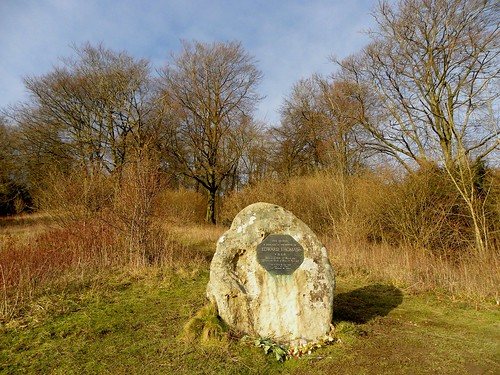
    And so we continued. March the 3rd, the poem I printed a week ago, was read at the memorial stone.

    The Thomas's first Steep cottage, Berryfield, on the right
    I noticed a badger- dug hole under a yew - and harts-tongue banks.


    Yew Tree cottage, their last Steep home


    I sold and signed some books and bought some of the excellent poem/woodcut illustrated cards, which you can see on the ETF website.
    There has been the most exciting find, books of Helen and Edward, with inscriptions, lost for eighty years. We will be hearing much more about them before long.

    The day ended with the annual meeting in the church and good news that by next year the memorial window which was smashed will be replaced by a replica to the same Whistler design.

    The New House - the poem from the broken window to be restored. It is about the Wick Green house where they were never settled or happy. I think of Yew Tree Cottage as having been a happier house on the whole.

    NOW first, as I shut the door,
    I was alone
    In the new house; and the wind
    Began to moan.

    Old at once was the house,
    And I was old;
    My ears were teased with the dread
    Of what was foretold,

    Nights of storm, days of mist, without end;
    Sad days when the sun
    Shone in vain: old griefs and griefs
    Not yet begun.

    All was foretold me; naught
    Could I foresee;
    But I learnt how the wind would sound
    After these things should be

    Saturday, March 2, 2013

    'March' and 'Oxford', the book, rerun to complete the Oxford story.   Edward Thomas's Birthday today, 3rd March.

    Edward Thomas's 'Oxford', printed in 1903, saved the family from the 'gutter and bankruptcy.'

    It was his first major commissioned work and came at a time when they were desperate for money after two years of living mainly from reviewing and single articles.

    Words or pictures first? My copy, a rather expensive birthday present, privileged the John Fulleylove paintings above the text., and Edward Thomas was commissioned to accompany them.


    Mine is the 'ordinary' edition, priced twenty shillings, and there was a limited Deluxe Edition, each copy numbered and signed by the artist, price two guineas.

    There are sixty full-page illustrations, of which eleven are reproduced in Lucy Newlyn's 2005 reprint,Signal Books. (I have used her introduction for most of the information in this blog.)

    Lucy writes that Fulleylove was an establishment Victorian painter, his trademark being historically important buildings painted with everyday, homely touches,'with a skilful choice of the unexpected as well as the typical aspects.' Hence a cat in a quad, people on bikes, figures coming round the corners of building.
    As Edward Thomas was also drawn to the unpretentious and everday, the two works suited each other, though they are entirely independant.

    Over a hundred years later the peopled pictures look very Edwardian and dated to my eyes. So many chaps in black gowns, a rarer sight these days, and how different from the French painters of the period, at least those we value most.
    I prefer the views of Oxford without people - Magdalen tower for example,(actually that is quite Impressionistic), the view from South Hinksey and the little churchyard of St Peter in the East.
    Saint Peter in the East

    'It is sweet to enter that peacefullest and homeliest of churchyards, St Peter's in the East, overlooked by St Edmund Hall and Queen's College and the old city wall. There is a peace which only the thrush and blackbird break-'

    The Text of 'Oxford'.


    ‘At sunset or dawn the city's place in the world, as a beautiful thing, is clearest. Few cities look other than sad at these hours; many, unless hid in their own smoke, look cheap. Oxford becomes part of the magic of sunset and dawn- is, as it were, gathered into the bosom of the power that is abroad. ‘


    Oxford' is a strange book, peopled with semi-fictitious characters, half amalgamations of people he knew, half imaginary, and many reflecting himself as a visitor or undergraduate. It is not everyone's cup of tea, although there is a good deal of humour in it.


    It’s acity with human influence of streets and architecture, the natural world everywhere intermingled with the buildings and the way the city 'steals out into the fields.' That is as important to him as well as the culture of books and librairies.


    He seems to have enjoyed looking back, but the book is not a personal account at all. Oxford gave him time to read and learn and make some friends, but his was not a typical student life because of the separate, secret life he had with Helen throughout.
    If you are interested in Oxford it's worth buying Lucy Newlyn's book.

    The poem: March -

    Edna Longley links this with Robert Frost's urging Edward Thomas to turn the prose of In Pursuit of Spring into poetry. 'March blends several March days and Thomas's perennial pursuit of spring into a quintessential symbol' Longley, The Annotated Collected Poems.
    MARCH

    Now I know that Spring will come again,
    Perhaps to-morrow: however late I've patience
    After this night following on such a day.

    While still my temples ached from the cold burning
    Of hail and wind, and still the primroses
    Torn by the hail were covered up in it,
    The sun filled earth and heaven with a great light
    And a tenderness, almost warmth, where the hail dripped,
    As if the mighty sun wept tears of joy.
    But 'twas too late for warmth. The sunset piled
    Mountains on mountains of snow and ice in the west:
    Somewhere among their folds the wind was lost,
    And yet 'twas cold, and though I knew that Spring
    Would come again, I knew it had not come,
    That it was lost too in those mountains chill.

    What did the thrushes know? Rain, snow, sleet, hail,
    Had kept them quiet as the primroses.
    They had but an hour to sing. On boughs they sang,
    On gates, on ground; they sang while they changed perches
    And while they fought, if they remembered to fight:
    So earnest were they to pack into that hour
    Their unwilling hoard of song before the moon
    Grew brighter than the clouds. Then 'twas no time
    For singing merely. So they could keep off silence
    And night, they cared not what they sang or screamed;
    Whether 'twas hoarse or sweet or fierce or soft;
    And to me all was sweet: they could do no wrong.
    Something they knew--I also, while they sang
    And after. Not till night had half its stars
    And never a cloud, was I aware of silence
    Stained with all that hour's songs, a silence
    Saying that Spring returns, perhaps to-morrow.

    Friday, March 1, 2013

    'March' and 'Oxford', the book, rerun to complete the Oxford story.

    Edward Thomas's 'Oxford', printed in 1903, saved the family from the 'gutter and bankruptcy.'

    It was his first major commissioned work and came at a time when they were desperate for money after two years of living mainly from reviewing and single articles.

    Words or pictures first? My copy, a rather expensive birthday present, privileged the John Fulleylove paintings above the text., and Edward Thomas was commissioned to accompany them.


    Mine is the 'ordinary' edition, priced twenty shillings, and there was a limited Deluxe Edition, each copy numbered and signed by the artist, price two guineas.

    There are sixty full-page illustrations, of which eleven are reproduced in Lucy Newlyn's 2005 reprint,Signal Books. (I have used her introduction for most of the information in this blog.)

    Lucy writes that Fulleylove was an establishment Victorian painter, his trademark being historically important buildings painted with everyday, homely touches,'with a skilful choice of the unexpected as well as the typical aspects.' Hence a cat in a quad, people on bikes, figures coming round the corners of building.
    As Edward Thomas was also drawn to the unpretentious and everday, the two works suited each other, though they are entirely independant.

    Over a hundred years later the peopled pictures look very Edwardian and dated to my eyes. So many chaps in black gowns, a rarer sight these days, and how different from the French painters of the period, at least those we value most.
    I prefer the views of Oxford without people - Magdalen tower for example,(actually that is quite Impressionistic), the view from South Hinksey and the little churchyard of St Peter in the East.
    Saint Peter in the East

    'It is sweet to enter that peacefullest and homeliest of churchyards, St Peter's in the East, overlooked by St Edmund Hall and Queen's College and the old city wall. There is a peace which only the thrush and blackbird break-'

    The Text of 'Oxford'.


    ‘At sunset or dawn the city's place in the world, as a beautiful thing, is clearest. Few cities look other than sad at these hours; many, unless hid in their own smoke, look cheap. Oxford becomes part of the magic of sunset and dawn- is, as it were, gathered into the bosom of the power that is abroad. ‘


    Oxford' is a strange book, peopled with semi-fictitious characters, half amalgamations of people he knew, half imaginary, and many reflecting himself as a visitor or undergraduate. It is not everyone's cup of tea, although there is a good deal of humour in it.


    It’s acity with human influence of streets and architecture, the natural world everywhere intermingled with the buildings and the way the city 'steals out into the fields.' That is as important to him as well as the culture of books and librairies.


    He seems to have enjoyed looking back, but the book is not a personal account at all. Oxford gave him time to read and learn and make some friends, but his was not a typical student life because of the separate, secret life he had with Helen throughout.
    If you are interested in Oxford it's worth buying Lucy Newlyn's book.

    The poem: March -

    Edna Longley links this with Robert Frost's urging Edward Thomas to turn the prose of In Pursuit of Spring into poetry. 'March blends several March days and Thomas's perennial pursuit of spring into a quintessential symbol' Longley, The Annotated Collected Poems.
    MARCH

    Now I know that Spring will come again,
    Perhaps to-morrow: however late I've patience
    After this night following on such a day.

    While still my temples ached from the cold burning
    Of hail and wind, and still the primroses
    Torn by the hail were covered up in it,
    The sun filled earth and heaven with a great light
    And a tenderness, almost warmth, where the hail dripped,
    As if the mighty sun wept tears of joy.
    But 'twas too late for warmth. The sunset piled
    Mountains on mountains of snow and ice in the west:
    Somewhere among their folds the wind was lost,
    And yet 'twas cold, and though I knew that Spring
    Would come again, I knew it had not come,
    That it was lost too in those mountains chill.

    What did the thrushes know? Rain, snow, sleet, hail,
    Had kept them quiet as the primroses.
    They had but an hour to sing. On boughs they sang,
    On gates, on ground; they sang while they changed perches
    And while they fought, if they remembered to fight:
    So earnest were they to pack into that hour
    Their unwilling hoard of song before the moon
    Grew brighter than the clouds. Then 'twas no time
    For singing merely. So they could keep off silence
    And night, they cared not what they sang or screamed;
    Whether 'twas hoarse or sweet or fierce or soft;
    And to me all was sweet: they could do no wrong.
    Something they knew--I also, while they sang
    And after. Not till night had half its stars
    And never a cloud, was I aware of silence
    Stained with all that hour's songs, a silence
    Saying that Spring returns, perhaps to-morrow.

    Monday, February 25, 2013

    Edward Thomas's Birthday, the Fellowship Walk.


    At Steep, 1914.

    Each year, on the Sunday nearest to Edward Thomas's birthday (3rd March), the Fellowship organises a walk in the countryside near his home at Steep, near Petersfield in Hampshire. This event is the main annual gathering for Fellowship members.
    There is time to contact the Fellowship membership secretary via the website, www.edwardthomasfellowship.org.uk if you would like to be part of it. I was asked by Richard Emeney, the chairman, to bring some volumes of 'A Conscious Englishman'along to sell over the lunch break, so I made a sheet of information to go with them.


    A Conscious Englishman, by Margaret Keeping, published February 2013, £9.99.
    £7.99 to Edward Thomas Fellowship members.
    ‘Did anyone ever begin to be a poet at thirty-six in the shade?’Edward Thomas asks.

    Following the outbreak of the First World War he does begin to write poetry after a lifetime of prose, and his self-doubt and melancholy starts to lift, helped by his close friendship with the American poet, Robert Frost.

    This poignant novel tells the story of the last years of the poet’s life. Told from the point of view of both Edward and his loyal wife Helen, it shows his wrestling with words along with marriage, children, the perpetual lack of money, and eventually with his conscience.

    Inspired by Edward and Helen’s writings, the novel is set against the beautifully evoked landscapes of Gloucestershire and Hampshire that offer the couple only partial peace.
    '[Margaret Keeping's] writing is very assured and she has the necessary eye for place, detail, weather and seasons to write about Edward Thomas...I hope the book will reach the wide audience it deserves and feel sure that many others will enjoy it as much as I have.' Linda Newbery, Costa prize judge, author of Set in Stone.

    'An absorbing book...This novel is very good on the influences behind the wonderful poetry.' Merryn Williams, The Oxford Times.

    ‘I've enjoyed reading the semi-fictional account of E.T.'s final years. I've been collecting Thomas's books since I was in the 6th form, and have almost a complete collection, and so I know a great deal about his life from the different biographies and collections of letters and memoirs.{On‘Dark earth/Light Sky’} Margaret Keeping's portrayal was more faithful and sensitive to the actual events. A Conscious Englishman' gains from the different narrative voices and perspectives, and includes many direct as well as oblique references to real events and to ET's writings. In particular the sections from Edward's consciousness are well-written and intelligently shaped.’Yorkshireman.
    ------------------------------------------------------------------------------
    Poem: March the Third.

    'As a birthday poem written shortly before Easter, March the Third subverts Christian celebration by making 'holy' and 'wild' interchangeable. A draft of lines 15-16 likens the birds' songs to canticles. Thomas was dissatisfied with the poem:"Perhaps I shall be able to mend March the Third. I know it must either be mended or ended." ' Edna Longley.

    Here again (she said) is March the third
    And twelve hours singing for the bird
    'Twixt dawn and dusk, from half past six
    To half past six, never unheard.

    'Tis Sunday, and the church-bells end
    When the birds do. I think they blend
    Now better than they will when passed
    Is this unnamed, unmarked godsend.

    Or do all mark, and none dares say,
    How it may shift and long delay,
    Somewhere before the first of Spring,
    But never fails, this singing day?

    And when it falls on Sunday, bells
    Are a wild natural voice that dwells
    On hillsides; but the birds' songs have
    The holiness gone from the bells.

    This day unpromised is more dear
    Than all the named days of the year
    When seasonable sweets come in,
    Because we know how lucky we are.
    It's rather intriguing that the 3rd March, unnamed - he means in the Christian calendar - is the big day for Edward Thomas enthusiasts, pagans, Christians or nothing at all!

    Saturday, February 23, 2013

    Edward Thomas and Oxford

    It's been suggested that I repeat early pages relating to settings in Thomas's earlier life.

    As I live in Oxford and have lived in or around the city since the mid-sixties it is important to me and I believe it was important to Edward Thomas, but he did not have a care-free time at University. He left school at just seventeen, his father insisting that he studied at home for Civil service entrance, but instead he set off to walk from London to Swindon, taking notes for the book that became A Woodland Life. He'd already had a dozen articles published in national journals and was earning money from them; this gave him courage to stand up to his father and the Civil service idea was dropped - instead he was to apply to Oxford.

    He had been encouraged in his writing by James Noble, writer and critic and father of Helen. Helen and Edward fell in love, and on her twentieth birthday became lovers. Biographers agree that for young people of their class this was not usual - some query Helen's motives, I think she was a very passionate person.

    In the autumn of 1897 he went up to Oxford to work for a scholarship while living in lodgings at 113 Cowley Road, as a non-collegiate student.


    Graffiti shops, Cowley Road, by Jane Hope, www.janehope.co.uk

    If you're not familiar with it, today Cowley Road qualifies for the word 'vibrant' - restaurants, bars, shops of every ethnicity, a live music venue, small independant cinema, a well-known early health-food shop, Uhuru, very trendy community market - so much I can't begin to describe it.
    East Oxford overall is also becoming the creative heart of Oxford, especially though not entirely, for younger artists and writers.What it's not known for is its architecture or for more established literary connections (Gerard Manley Hopkins referred to East Oxford as Oxford's 'base and brickish skirt'.)
    Not like North Oxford which is peppered with blue plaques.

    I would very much like to see the house, 113, marked in some way. A young stone-mason, Richard Morely, happened to be living there, and we talked about the possibility of doing something, with the help of the Edward Thomas Fellowship. (Richard remains in Oxford and can be contacted for commissions - morleymasonry@hotmail.com)
    The wording was agreed and a design made, but it is on hold at the moment.


    Oxford 'Entrance'

    The non-collegiate scheme was not unlike the set-up in which I took my B.Ed, and Edward was not going to be satisfied with it. He had to pass exams in Greek, Latin and logic with Mathematics, and failed three times to pass what was in effect the Oxford entrance exam. He went to lectures in the morning, walked in the afternoon, worked for the rest of the time.

    Edward wrote very loving letters to Helen almost daily,

    'I am very happy with you, very content, and very hopeful.... you alone are beautiful. I can often doubt whether what I see is beautiful; but I know....{unfinished}
    He took long walks into the country - 'Late flights of larks were singing and darting about in the last gardens of the town and the first fields of the country.' -,wrote 'verses' and wanted her opinion, asking if she thought them ludicrous. He treated her as an intellectual equal at that time, suggesting reading they could discuss later.
    Many letters are sexually charged, and one refers to the rights and wrong of 'preventatives' - contraception. In others Edward is distinguishing lust from love, saying that love lasts and also allows room for other things, whereas lust is obsessional and allows room for nothing else.

    As always though, he worked hard and eventually won the history scholarship he needed to go to Oxford 'proper', to Lincoln College to read history.

    There was of course no such thing as 'English literature' in conservative Oxford; it carried an association of dissent and belonged in Liverpool and London. But it's clear that Edward spent a good deal of his time reading literature, for pleasure and because he was still selling his articles to journals.


    The Turl
    From The Word, (which goes on to concern something quite different from the formal learning at its beginning):


    From THE WORD.
    There are so many things I have forgot,
    That once were much to me, or that were not,
    All lost, as is a childless woman's child
    And its child's children, in the undefiled
    Abyss of what can never come again.
    I have forgot, too, names of mighty men
    That fought and lost or won in the old wars,
    Of kings and fiends and gods, and most of the stars.
    Some things I have forgot that I forget.


    And here is part of a poem from Branchlines, Edward Thomas and Contemporary Poetry, edited by Guy Cuthbertson and Lucy Newlyn, in which fifty-three of today's poets respond to him in their own work.

    This is Robert Crawford on a sense of his presence in Oxford still; Guy, his former student, is the man the poet met by chance, and certainly for me 'Your man, Edward Thomas,' is exactly right. That is Guy, and an ever-helpful guide and clue-dropper to me.

    The second stanza is about the collection of letters between Edward and Robert Frost, 'Elected Friends', edited by Matthew Spencer.

    E.T.

    'somehow someday I shall be here again'
    When we met by chance on the Turl, were you aware
    Yon door opposite was exactly the dark door where
    Your man, Edward Thomas, before he became a poet,
    Nipped out of the world and into Lincoln College?
    Odd we met and spoke about him there.


    Odd, too, in St Louis, seeing in the Left Bank bookstore
    That book of his to-and-fro with Robert Frost.
    I bought it on impulse - his finest writing
    So lightly right I can't get away from him,
    Though all the time I know he isn't there.


    Any comments about the plaque idea would be very welcome.